Small AI models let drones autonomously identify and attack battlefield targets
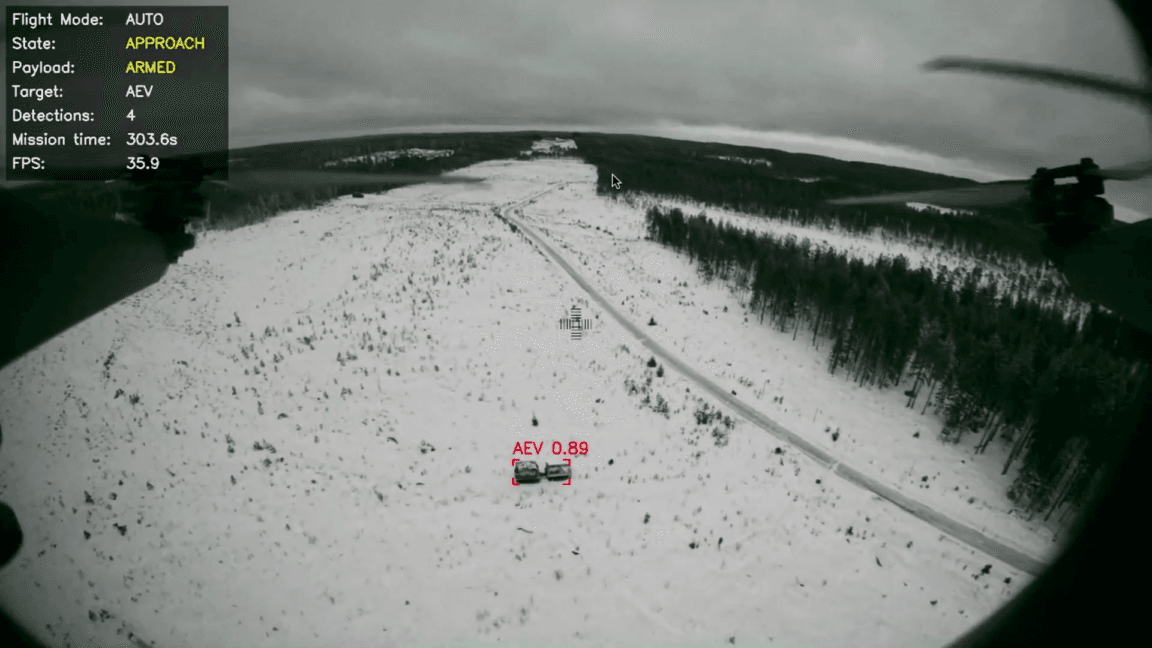
A NATO-backed Swedish startup, Scaleout Systems, is deploying compact AI models that can run on drones and forward-base hardware to detect, prioritize and engage battlefield targets. The company demonstrated an autonomous loitering munition in the ALMA program that used onboard AI to locate and strike a designated high-value target while still permitting human oversight.
Why It Matters
The work shows how decentralized, edge-focused AI and federated learning can let military systems continue functioning amid disrupted communications or contested networks, potentially changing how reconnaissance and strike missions are conducted on modern battlefields.
Key Facts
- Company: Scaleout Systems
- Founded: 2018 (Uppsala University researchers)
- Pivot to defense: After Russia's full-scale invasion of Ukraine in 2022
- NATO program: Selected for DIANA Challenge Program (2025)
- Project names: Federated Aerial Intelligence for Recon; Affordable Loitering Modular Ammunition (ALMA)
Scaleout Systems, a Swedish startup started by researchers from Uppsala University in 2018, has adapted its edge-focused machine learning technology for military use following Russia’s 2022 invasion of Ukraine. Rather than relying on large, centralized AI models from major cloud providers, the company emphasizes compact computer-vision models that can run on the constrained hardware found in small drones, pilot tablets and forward-deployed workstations. The company was selected for NATO’s Defence Innovator Accelerator for the North Atlantic (DIANA) Challenge Program in 2025 and has worked on a Federated Aerial Intelligence for Recon effort to tailor models to edge computing hardware. Scaleout’s approach uses intermittent, selective updates between local devices and platoon- or company-level computing nodes; those nodes aggregate battlefield data to retrain models and then distribute improved versions back to edge devices when connectivity allows. Scaleout demonstrated the approach publicly through exercises and projects including the ALMA program led by BAE Systems Bofors. At a Winter Demo 2026 event in Sweden, an ALMA loitering munition used onboard AI to detect, identify, geolocate and prioritize potential threats, then autonomously flew to and struck a mission-defined high-value target — an armored engineering vehicle — while retaining the option for human control. The company also ran tests at a Swedish Air Force base in Uppsala in June that showed a forward-deployed computing node could continue inference and active learning after losing contact with a central lab node; once connectivity returned, the local model updates were shared. Scaleout says this federated learning strategy could allow AI models to continuously improve from distributed sensor data and potentially be scaled across allied forces and regions.
Keep Reading

Crusoe raises $3.9B to build massive data centers and small modular ‘AI factories’

Scott, Baldwin ask FTC to investigate Amazon, Walmart AI over ‘Made in USA’ fraud detection

Khosla-backed Mazama Energy just raised $135M to drill deeper into super-hot-rock geothermal

Moore says he would ‘absolutely sign’ statewide data center moratorium
Original source: Ars Technica AI